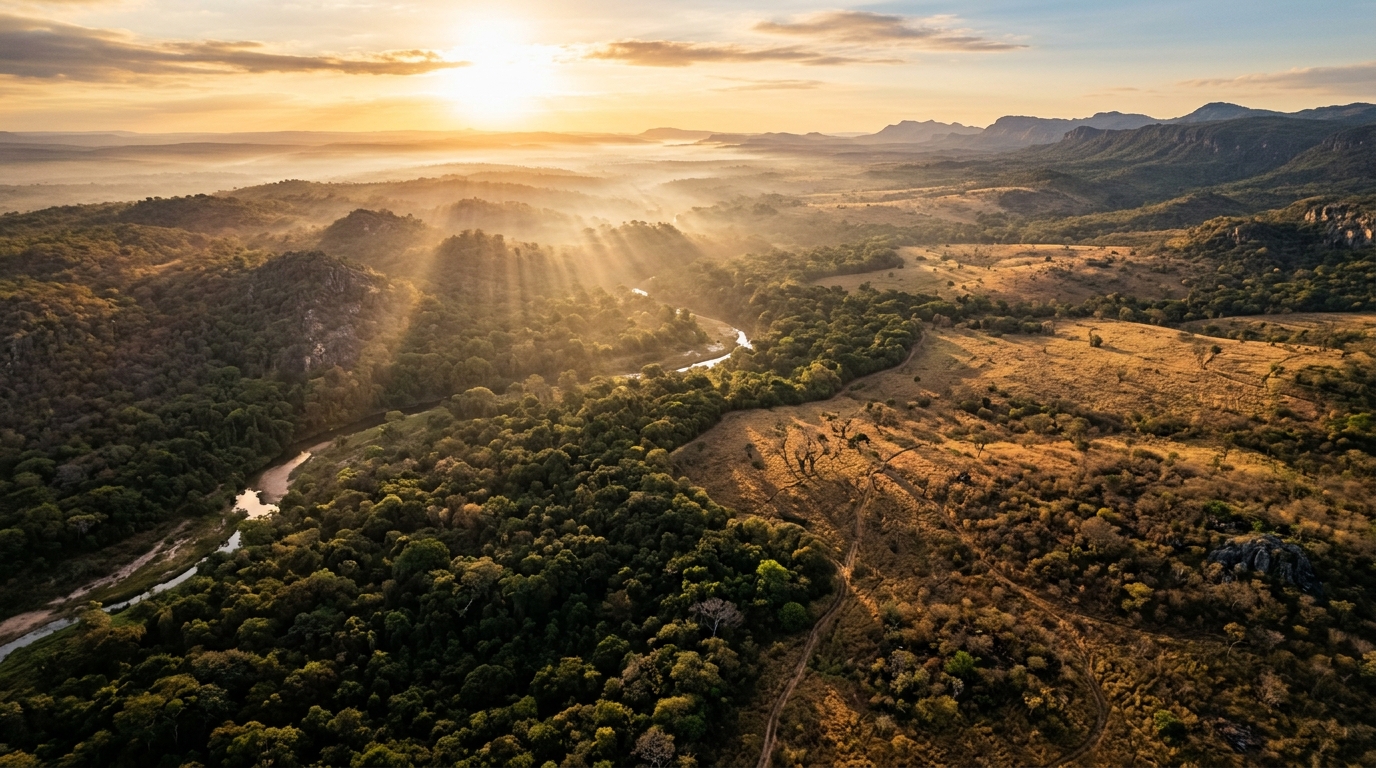
For more than two decades, corporate imaginations and climate venture capital flows were almost monopolistically concentrated within the Amazon basin. The underlying assumption seemed straightforward: the world’s largest rainforest holds the greatest density of aboveground biomass visible to optical satellites. However, the analytical maturity of international decarbonization funds and the scientific assurance requirements of the Brazilian Emissions Trading System (SBCE), enacted under Law No. 15,042/2024, are rapidly redirecting institutional capital toward Brazil’s long-overlooked biomes: the Cerrado savanna and the Caatinga drylands.
Far from being secondary ecosystems, these regions harbor unique ecological, financial, and land-tenure advantages that have established their conservation and restoration projects as the most sought-after assets in Nature-based Solutions (NbS) portfolios. By combining the so-called “inverted forest” — where deep root networks secure carbon against wildfires — with significantly lower structuring costs per hectare and certified social co-benefits, the Caatinga and Cerrado represent the forefront of high-integrity carbon credit origination in Brazil.
📌 Executive Summary: Key Takeaways
- The Resilience of the Inverted Forest: In the Cerrado and Caatinga, up to 70% of plant biomass is stored underground in extensive root networks, providing geological permanence and virtually eliminating risk from surface wildfires.
- Capital Efficiency and Lower Land Costs: Structuring Environmental Asset Projects (PAA) across the semi-arid region and MATOPIBA costs a fraction per hectare compared to speculative Amazonian land.
- Financial Premium for Social Co-Benefits: Corporate buyers pay a 20% to 40% premium for Cerrado and Caatinga credits certified under CCB (Climate, Community & Biodiversity) standards, supporting desertification mitigation and water security.
The Science of the Inverted Forest: Why Underground Carbon Holds Superior Permanence
Carbon sequestered in deep root biomass and organic matter throughout Cerrado and Caatinga soils exhibits greater temporal permanence and lower vulnerability to extreme climate shocks than tree canopies in humid rainforests. While Amazonian trees store roughly 80% of their mass above ground, native savanna vegetation has evolved over millennia to build a massive subterranean forest.
According to empirical research by Embrapa, root systems of native Cerrado trees (such as barbatimão, pequi, and pau-terra) and drought-adapted Caatinga shrubs (such as catingueira and juazeiro) routinely reach depths between 10 and 15 meters. This structural architecture serves as a remarkably resilient carbon sink: even during prolonged dry spells or seasonal surface brush fires, subterranean carbon does not burn or oxidize back into the atmosphere, safeguarding the permanence of credits traded on international climate exchanges.
Furthermore, converting pristine native areas into degraded pastures depletes this deep soil carbon reservoir. Projects that successfully prevent deforestation and ecological degradation across these dry forests deliver undisputed additionality under the latest international carbon accounting methodologies.
Strategic Comparison: Amazon vs. Cerrado vs. Caatinga
For institutional investors and agricultural landowners, capital allocation decisions depend on strict metrics of carbon permanence, land acquisition costs, and regulatory certainty.
| Evaluation Metric | Amazon Rainforest | Cerrado Savanna | Caatinga Drylands |
|---|---|---|---|
| Biomass Distribution | 80% canopy / 20% roots | 30% to 40% canopy / 60% to 70% roots | 40% canopy / 60% roots & soil |
| Reversal Risk from Wildfire | High (canopy loss and visible biomass decay) | Very Low (deep root network shielded) | Low (exceptional xerophytic resilience) |
| Average Structuring & Land Cost | High (fluvial logistics and costly enforcement) | Moderate (established transport corridors) | Competitive (accessible land tenure per ha) |
| Co-Benefit Premium (CCB) | Moderate (already priced in by markets) | High (aquifer and watershed replenishment) | Maximum (desertification fight & social PSA) |
| Suitability for PAA Projects | Best for vast continuous tracts | Ideal for legal reserve farm surpluses | Optimized for rural landowner consortia |
Landowners interested in evaluating project eligibility and estimated annual carbon revenue for their native vegetation can access the free ENSUC Carbon Credit Calculator.
The PAA Model: How Landowners in the Semi-Arid and Center-West Monetize Native Lands
The Environmental Asset Project (PAA) framework allows rural property owners to monetize surplus Legal Reserves and Permanent Preservation Areas (APP) without relinquishing land ownership or interrupting active farming operations. In regions prone to cyclic droughts or with rocky terrain unsuitable for grain cultivation, ecological conservation often becomes the highest-yielding crop per hectare.
The structured PAA implementation methodology follows rigorous governance standards:
- Cadastral & Title Due Diligence: Verification of the Rural Environmental Registry (CAR), notary registry deeds, and confirmation of zero overlap with public lands or conservation units.
- Remote Sensing & LiDAR Biomass Mapping: Precise quantification of aboveground and underground phytomass density through multispectral satellite imagery calibrated with local soil sampling.
- International Certification & Validation: Registration under rigorous global standards such as Verra (VCS + CCB) or alignment with Brazilian regulated market standards.
- Structured CRVE Offtaking: Commercialization of issued credits to compliance buyers under the SBCE or multinational corporations pursuing verified Net-Zero roadmaps.
To examine the step-by-step implementation for rural properties, explore the Environmental Asset Projects (PAA) Methodology.
Social Co-Benefits: Why Global Markets Pay More for Caatinga Offsets
Modern carbon pricing is no longer restricted to isolated $tCO_2e$ metric units; international buyers actively reward projects generating tangible human impact and watershed resilience in semi-arid environments. The Caatinga is the only biome exclusive to Brazil, supporting over 27 million inhabitants while facing severe desertification risks amplified by global heat stress.
When a Caatinga conservation project earns dual accreditation under standards like Climate, Community & Biodiversity (CCB), corporate buyers from Paris Agreement signatory nations recognize clear risk mitigation. Carbon investments directly finance freshwater spring conservation, sustainable beekeeping, and rural family retention, elevating carbon offsets into catalysts for regional socioeconomic stability.
With the legal certainty established by Law No. 15,042/2024 and the rising benchmark integrity of the ICVCM (Integrity Council for the Voluntary Carbon Market), verified credits originating from resilient Brazilian biomes have emerged as a premier defensive asset against global carbon price volatility.
To explore strategic opportunities across Brazil’s diverse ecosystems, read our comprehensive guide on Brazilian Biomes and Carbon Markets, review compliance rules under the SBCE Regulatory Framework, or contact our carbon advisory team for a customized assessment of your forestry assets.
International Editions
This technical ENSUC report is available in multiple languages for global partners and investors: